The range claim is not your range. Test the route.
Handheld-radio range changes with hills, buildings, trees, antenna position, battery condition, and the location of both people. A useful plan records where a message is readable, where it fails, and what each person does after failed contact.
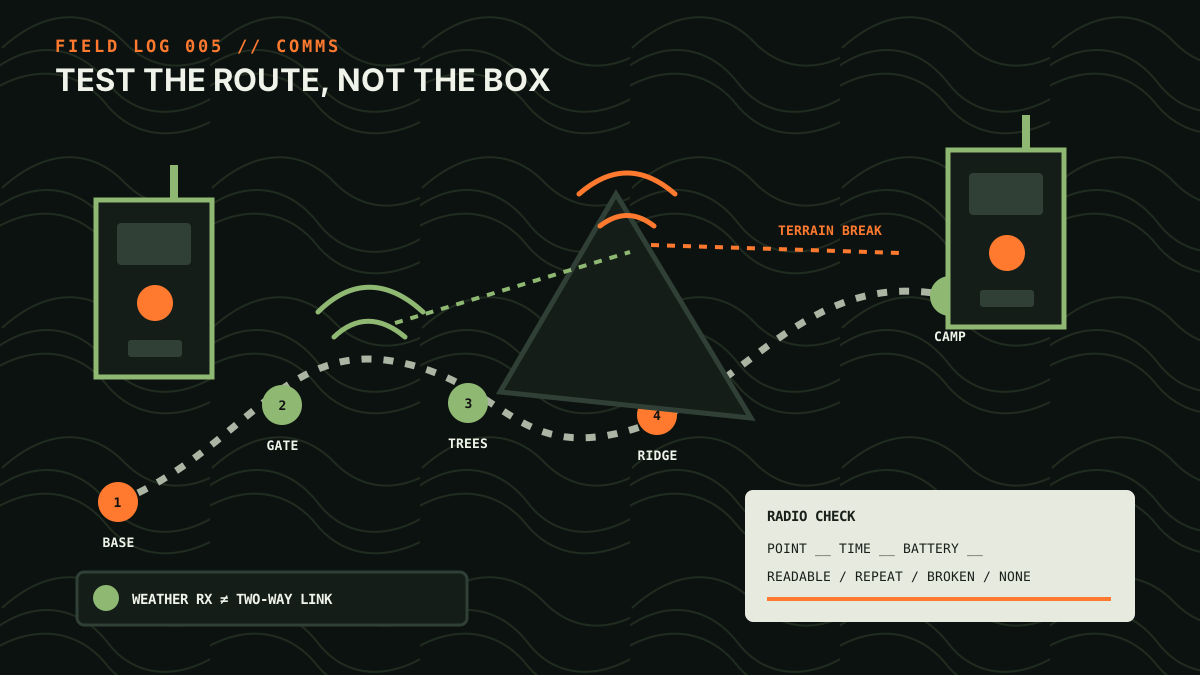
Give the radios one specific job
“Emergency communications” is too broad to test. Decide who must talk to whom and why. A pair of short-distance radios may be useful for coordinating two vehicles in a convoy, keeping contact between a trail group and a nearby base camp, or checking on a family member elsewhere in a large building. They are not automatically a route to 911, search and rescue, or someone monitoring at home.
Write a sentence with both endpoints: “One radio stays at the trailhead vehicle; the other travels the lower loop and reports at checkpoints 1 through 5.” Add the separation time, route, weather, turnaround time, and the action to take after a missed call. The radio now has a testable job.
Know which service you are operating
In the United States, the FCC defines Family Radio Service as short-distance, two-way voice communication between low-power handheld radios. FRS units are licensed by rule when used within the FCC requirements; the equipment must be certified for FRS. General Mobile Radio Service is a different service that requires an individual license for ordinary operation and has its own equipment and identification rules.
Read the radio label and current manual. Confirm the FCC certification and service instead of assuming that any programmable handheld may transmit on any displayed frequency. Do not modify the radio, attach an unapproved antenna, increase power, or program frequencies unless the equipment, license, and current rules permit it. If the device can operate in more than one service, record the exact mode being tested.
FRS channels are shared. Other people may use them, and channel or “privacy code” settings do not turn a transmission into private speech. Those settings can keep a receiver quiet until it hears the matching code; they do not prevent someone else from receiving the signal. Keep names, medical details, access codes, and other sensitive information out of routine radio traffic.
Rules can change, and radio rules differ outside the United States. Check the FCC’s current Part 95 rules or the communications regulator for the place where the radio will be used. An actual emergency does not make routine illegal practice a sensible plan; the skill has to be built before the emergency.
Separate warning, group contact, and rescue
| Communication need | Tool role | Limit to write down |
|---|---|---|
| Receive official weather warnings | NOAA Weather Radio receiver with the correct local transmitter and, where used, SAME programming. | It is generally one-way reception; coverage depends on transmitter, terrain, receiver, and location. |
| Talk within a nearby group | Compatible legal two-way radios on an agreed shared channel. | Both radios must be on, charged, configured alike, within practical range, and actively monitored. |
| Reach public safety | Call 911 when possible. 911.gov says voice is best; text if you cannot call and local text-to-911 is available. | A group radio is not a substitute for verified emergency contact coverage. |
| Call for help beyond cellular coverage | A properly registered and maintained distress beacon or active satellite communicator may fill a different role. | Coverage, view of sky, plan status, registration, battery, testing, and response workflow are device-specific. |
NOAA Weather Radio broadcasts watches, warnings, forecasts, and other hazard information around the clock, but coverage is not universal. The National Weather Service says terrain, distance, receiver quality, and receiver location affect what can be heard. Program and test the actual receiver against the local transmitter and weekly test schedule. Hearing a weather broadcast proves reception at that spot; it does not prove that your handheld can transmit to another person.
Build five checkpoints from terrain, not distance alone
The FCC calls FRS a short-distance service. NTIA propagation resources show why a mileage promise is weak evidence: at VHF and higher frequencies, terrain and antenna height significantly affect signal loss. Buildings, hills, a drainage, dense vegetation, a vehicle body, and the operator’s own body can change the path.
Pick checkpoints that represent the route’s actual transitions:
- Baseline: both operators in open ground with visual contact.
- Building edge: one operator just inside or behind the structure used in the plan.
- Vegetation: the normal trail or property point where trees and brush increase.
- Terrain break: beyond a low ridge, bend, or drainage where direct visual contact is lost.
- Operational limit: the farthest point the plan actually requires, reached by a safe established route.
Plot every point on a paper map. Give it a short name that can be spoken clearly: “Gate,” “Bridge,” “Lower Bend,” “Ridge Turn,” and “Camp.” Record whether each operator is outdoors, inside a vehicle, inside a building, or below the surrounding terrain. A result without that context cannot be repeated.
Use one short message at every point
Before separating, confirm channel, code or squelch setting, volume, key lock, battery indicator, and the location of the push-to-talk button. Give the radios plain, distinct call signs based on roles rather than personal names. Practice the sequence face to face:
Base replies: “Route, this is Base. Readable. Lower Bend at 10:20. Continue to Bridge and call at 10:30.”
The first operator should pause briefly after pressing push-to-talk before speaking so the start of the message is not clipped. Speak across the microphone at the distance the manual specifies. Keep the antenna upright and the radio clear of metal and your body as much as practical. Do not wave the radio overhead or climb onto unstable terrain to force a connection.
Grade the whole message, not whether a burst of sound came through:
- Readable: call sign, checkpoint, time, and instruction are understood without a repeat.
- Repeat needed: contact exists, but one or more critical details are lost.
- Broken: only fragments or the call tone arrive; the message cannot guide a decision.
- No contact: neither side can establish a usable exchange during the scheduled attempt.
Log the result at both ends. If one person hears well while the other does not, the link is still unsuitable for a two-way plan.
Run the failed-contact sequence exactly once
A missed call becomes dangerous when each person invents a different response. Write the sequence in advance and keep it short:
- At the scheduled time, call twice using the agreed call signs and checkpoint.
- Check volume, channel, code setting, key lock, battery seating, and whether an accessory plug is partially connected.
- Move only to the preselected nearby retry point if it is safe: a few steps away from a building or vehicle, or back to the last marked open point. Do not leave the route or climb exposed terrain.
- Retry at the written interval. If there is still no contact, follow the regroup or escalation time on the plan.
The fallback might be “both operators return to the last confirmed checkpoint,” “the route operator returns to Base,” or “Base calls the overdue-action contact at 11:00.” It depends on the route and risk. The key is that both people carry the same instruction and do not start searching in different directions.
Test batteries as part of the route
A radio that works only with a fresh charging cable on the kitchen counter is not ready. Record battery type, charge date, approximate age, spare location, and how the radio behaves when power becomes low. Cold can reduce available battery performance; keep the unit and spare within their manufacturer temperature limits and protect them from water.
Repeat the baseline exchange after the route test. If audio, transmit power, display, or battery indicator changed, record it. For replaceable cells, use only the type the manufacturer specifies and prevent loose batteries from shorting against metal objects. For rechargeable packs, test the actual charging method that will be available in the vehicle or outage kit.
Weather reception and transmitting draw different amounts of power. Do not leave a two-way radio scanning every function and assume it will last for the scheduled contact window. Set a monitoring schedule that fits the manual and plan.
What to buy only after the drill
The failed points reveal the useful requirement. If rain made controls difficult, prioritize weather protection and glove-friendly operation. If operators could not tell whether the correct channel was selected, prioritize a clear display, key lock, and simple controls. If the route exceeded FRS capability, changing to another legal service may help only when the licensing, equipment, antenna, terrain, and people fit the plan; more advertised power does not remove a hill.
Evaluate documented specifications and support:
- FCC certification and the exact radio service;
- clear manual, channel chart, and legal operating modes;
- water and dust rating with test standard stated;
- controls usable with the intended gloves, vision, hearing, and dexterity;
- battery type, runtime test conditions, replacement availability, and charging options;
- headset or microphone compatibility only when needed and tested;
- NOAA Weather Radio reception and SAME alerting only when those functions match the warning plan;
- warranty, repair path, and current manufacturer support.
A radio pair is useful when the route log says where it works and the people know the script. Keep the result with the carry-kit audit. For backcountry movement, add it to the lost-hiker decision plan without treating it as a rescue guarantee.
The one-page radio route log
| Checkpoint | Time / setting | Result | Retry / action |
|---|---|---|---|
| Baseline | Channel, code, battery, weather | Readable / repeat / broken / none | Confirm shared setup |
| Building edge | Inside/outside, door, vehicle | Both directions | Move to marked outdoor point |
| Vegetation | Leaf cover, rain, antenna position | Both directions | Return to last good point |
| Terrain break | Ridge/drainage, map point | Both directions | Use written missed-call plan |
| Operational limit | Actual required endpoint | Both directions | Accept, redesign, or add another system |
Date the sheet and repeat it when leaves, snow, buildings, route, batteries, radios, antenna configuration, or operators change. The useful claim is narrow and honest: “These two configured radios carried a readable message between these marked points under these conditions.”
Sources checked
- Electronic Code of Federal Regulations: Family Radio Service
- Electronic Code of Federal Regulations: General Mobile Radio Service
- Federal Communications Commission: Personal Radio Services Rules
- National Weather Service: NOAA Weather Radio All Hazards
- 911.gov: Frequently Asked Questions About Calling 911
- NTIA Institute for Telecommunication Sciences: VHF and Higher-Frequency Communication Performance
Reviewed October 7, 2026. Confirm current radio rules, licensing, local emergency contacts, weather-radio coverage, route conditions, closures, and device instructions before use.